
Over tea in Dakar: How one scholar built digital health tools by first learning to listen
Suhan Asaigoli ’27 spent his Professional Experience summer with the Clinton Health Access Initiative in Senegal and found that the best technology starts with understanding a community, not designing for it.
For Suhan Asaigoli ’27, some of the most formative learning of the summer happened over tea.
Not in conference rooms or at computer screens, but at home with his host family in Dakar sipping attaya, the minty green tea enjoyed after meals throughout Senegal. In those first few weeks, as the steam rose from small glasses, Suhan’s host father shared what it means to call Dakar home.
The culture. The food. The warmth of family life. And also, the challenges.
Dakar is a financial and diplomatic hub with a high expat presence. It’s one of the most expensive cities to live in across Africa. Many families sacrifice meals, electricity, running water, and personal health just to stay.
“The stories gave me a driving force to innovate this summer,” Suhan said, “and reminded me of why it was so important for me to work and learn in Dakar this summer.”
For a student spending his summer building digital health tools at the Clinton Health Access Initiative (CHAI), those tea conversations became the foundation of his work.
The problem isn’t just biomedical
Many of the world’s biggest health challenges aren’t simply medical problems. They’re problems of access, coordination, and trust.
Community health workers, clinics, governments, and health programs often operate with fragmented information and limited digital infrastructure. It becomes difficult to deliver timely, equitable care. Critical decisions get made without complete information. Communities that need help most remain hardest to reach.
Suhan’s work centered on strengthening these systems by designing practical digital tools that help health workers, program managers, and Ministries of Health make better decisions and ultimately reach the communities that need them most.
Building across borders, languages, and diseases
Working on CHAI’s Digital Health team, Suhan contributed to projects spanning neglected tropical diseases, women’s and maternal health, family planning, and AI innovation. He built digital tools interfacing directly with Ministries of Health, community partners, stakeholders, and community members across English-, French-, and Portuguese-speaking African countries.
The charge: figure out how to better represent the realities of local communities in public health interventions, create tools that empower community health workers, and resolve fragmentation between institutions and the communities they serve.
“Over my time in Dakar, I’ve contributed to developing a few web and mobile applications, digital public good repositories, and tools for leveraging AI for program management and disease surveillance,” Suhan said, “all with a philosophy of building sustainable, locally championed solutions.”
That meant quickly absorbing context for each project: disease pathology, various community actors, program structures. There were never straightforward solutions.
“Every day at CHAI, people are trying out new technologies, embracing new approaches, and resisting a one-size-fits-all approach,” Suhan said.
He spent a week in Saly with the CHAI Senegal and Global Digital Health team, developing Pisa, an app for women’s and maternal health created in conjunction with the Ministry of Health. He learned to work across languages, health systems, and cultural contexts.
And he learned something crucial about building technology for health.
Premature optimization is the root of all evil
There’s a saying in programming: premature optimization is the root of all evil.
For Suhan, that principle became central to his summer.
“There’s no point in building a ‘silver bullet’ tool that has cutting-edge features but is too complicated for a community health worker,” he said.
Aggregate statistics like incidence and prevalence may tell part of a story, but often there’s nothing better than hearing someone’s lived experience. Design choices that felt natural to Suhan were built off schemas from a different place, for different communities; they might not be legible to the people who would actually use what he built.
“I had to recognize the tendency to optimize to what my eye was attuned to and refocus on the needs of users in the community,” Suhan said. “Which was a big competency strengthened.”
He had to unlearn engineering based on his preconceived notions, and learn to ask: What data matters? What does this data serve? How do we build something people in the community can actually use?
The answers came from listening. From tea conversations with his host family. From community health workers describing their days. From understanding context before rushing to solutions.
What home teaches
Suhan visited the African Renaissance Monument, the tallest statue in Africa, which stood just a short walk from his home. He returned often, both for its sweeping view of the city and for what it represents: Senegalese independence, cultural pride, and a broader vision of African renewal and possibility.
He visited Gorée Island and the Maison des Esclaves, including its well-known Door of No Return.
“A sobering and deeply moving experience,” he said. “It offered a powerful reminder of the violence of the transatlantic slave trade and of the colonial legacies whose effects continue to shape Senegal, Africa, and the wider world.”
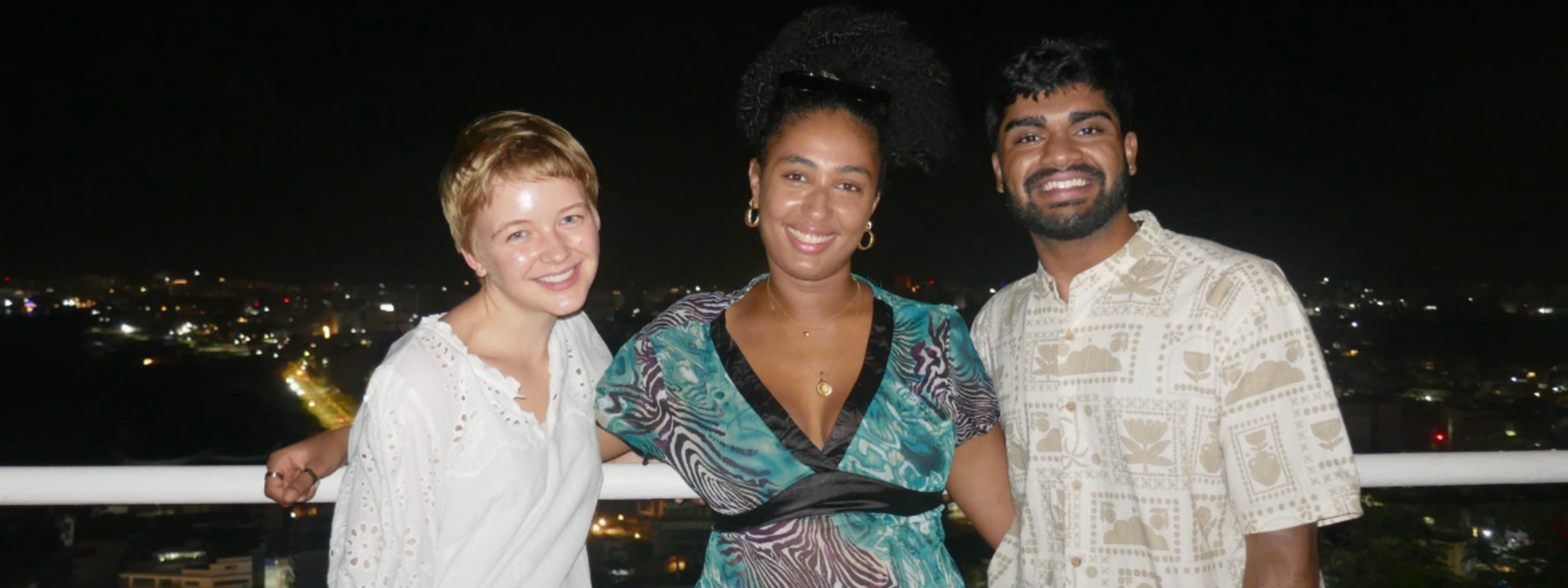
And he explored Dakar with fellow scholars Anjali Sankale ’28 and Susannah Owen ’28, who were there conducting their own Global Perspective projects.
“I was inspired by how they both engaged with Senegal through exciting questions and experiential engagement,” Suhan said.
But what grounded him most was his host family, shared meals, conversations, celebrations, and everyday routines.
“They made my time in Dakar feel warm, grounded, and deeply personal,” Suhan said. “I learned far more about Senegalese life than I ever could have through work alone, and I felt welcomed as part of the family.”
Building systems that serve communities
For Suhan, who wants to dedicate his career to work at the intersection of medicine, engineering, and community health, this summer reinforced what matters most.
“I want to contribute to research and build digital health systems that leverage the cutting-edge while thoughtfully representing the communities they serve, translating local knowledge into sustainable solutions that strengthen health systems and improve care,” he said.
He learned that innovation doesn’t start with technology. It starts with understanding, with listening closely enough to know what communities truly need.
“My summer with CHAI Senegal has been an extraordinary blend of learning, friendship, and growth,” Suhan said. “Living in a country where I often struggled to speak the language reminded me that smiling, curiosity, humility, and genuine care are universal. The most meaningful innovations of my summer began with listening closely enough to understand what communities truly need.”